Overall Rating
- Ease of use(5)
- Uphill behaviour(5)
- Downhill behaviour(4.5)
- Weight(4.5)
Summary
An evolution of an already highly successful model, which thanks to the latest improvements has all the credentials to appeal to a very wide range of ski mountaineers. A ‘ruffian’ binding, in short, which winks at those looking for ease of use and performance combined with low weight and price.
Pros
- Precise front hooking
- Two-position heel lift functionality
- Well-manageable toe lever
- Heel with ample adjustment
Cons
- Limited DIN for heavy and aggressive skiers
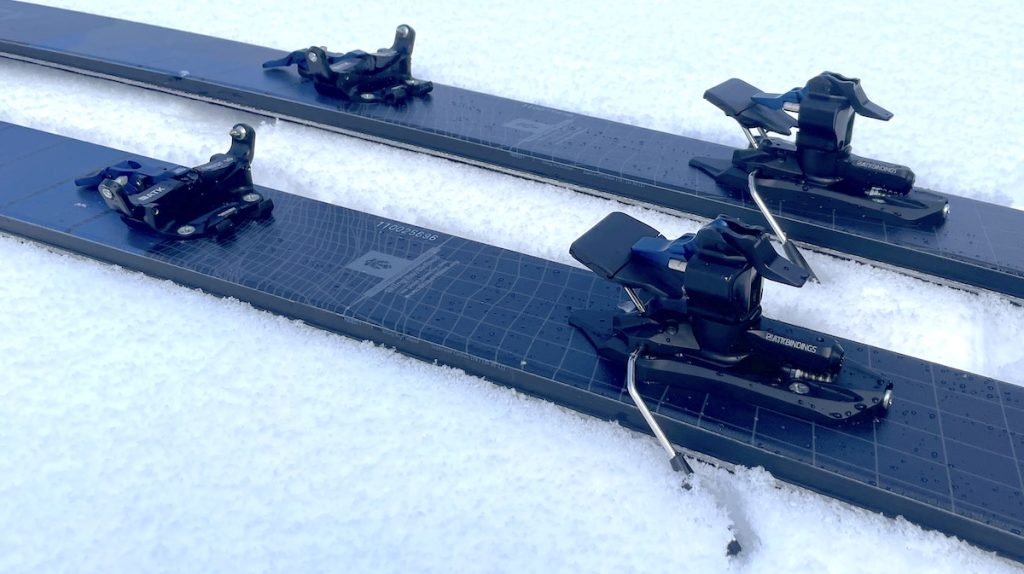
The ATK Crest 10, as theModenese company defines it, represents the latest evolution of the Crest project born a few years ago. Gathering feedback from enthusiasts and professionals, ATK has introduced some improvements that now make it even more versatile and functional, moving the bar upwards in the touring segment. In particular, the Crest 10 has a feature that distinguishes it from previous models and, to some extent, from the competition: automatic ski brake retraction.
Technical features of the Atk Crest 10
- Materials: Finely machined 7075 aluminium and stainless steel
- Vertical and lateral heel release, adjustable in positions 4 to 10
- Integrated ski-brake with uphill lock via heel rotation
- Heel with 3 walking positions: base and two heel lifts
- Heel lift with magnetic locks and can be operated with poles
- Easy entry system: toe box geometry with simple step-in
- Removable crampon housing
- Ski-brake width 86, 91, 97, 102 mm
- Skier weight: 50-110 kg
- Binding weight: 295 gr, each
- Country of construction: Italy
- Link to the manufacturer
Test mode
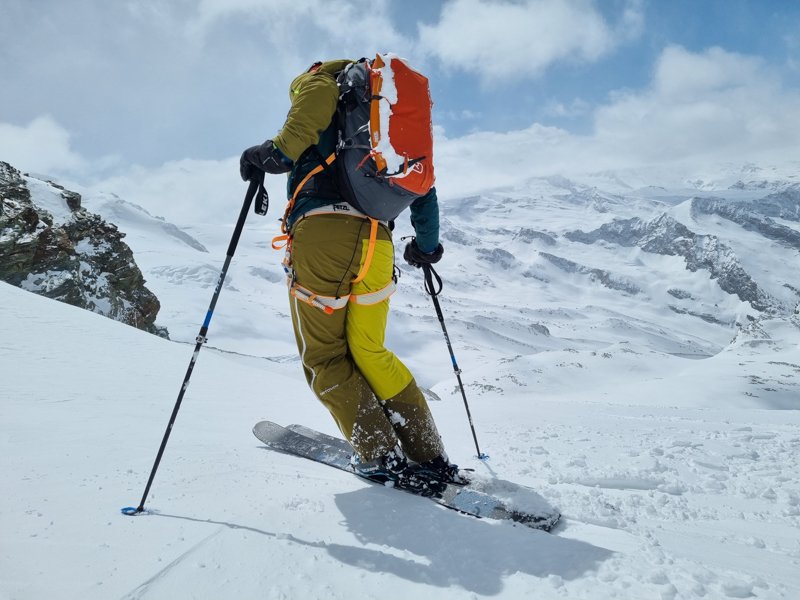
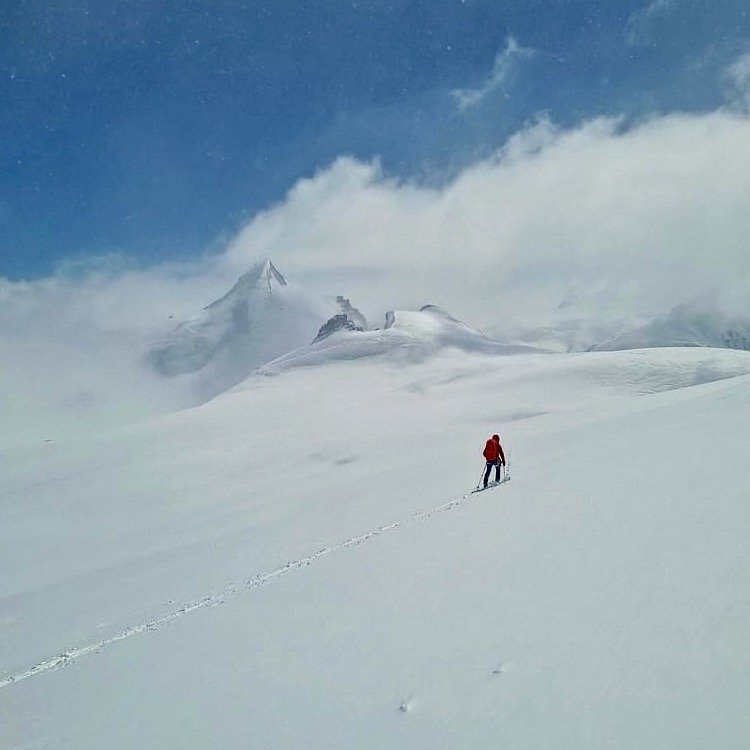
I tested the ATK Crest 10 on spring and summer 2024 ski mountaineering outings in the Alps. Given the conditions, I went on tours with altitude differences of around 800 to 1900 D+, including on glaciers and a few 4000 m peaks, with snow ranging from powdery on hard-packed to transformed, and unfortunately not forgetting the crust.
The skis used were Majesty Superwolf Carbon season 24/25. The approach to skiing has been that of touring at altitude, with a few attempts at mountaineering, favouring downhill slopes where I also look for speed, wide-radius turns and therefore high forces transmitted to the binding.
Atk Crest 10 on-site test
How they look
The Crest range is perhaps ATK’s best-selling range, as it can be mounted on the most popular ski segments, namely those with a centre between 85mm and 100mm. I appreciated its laser-finished materials , which facilitate functionality as well as aesthetics. Aluminium 7075, stainless steel and advanced polymers for the parts that work in vibration and loadabsorption.

The tip of the Atk Crest 10
The tip is called ‘Speed’ and has been redesigned to improve downhill performance. Now the holes for installation on the ski are no longer symmetrical: a hybrid drilling pattern has been adopted, narrow in the front holes and wide in the rear ones. The tip also includes the Snowpack Proof System which, unlike the previous version, now has springs that are hidden from view, thus preventing ice or snow from compromising the functionality of the locking/release mechanisms. One really appreciates this feature, especially in deep snow and cold temperatures, especially when it is time to repack.
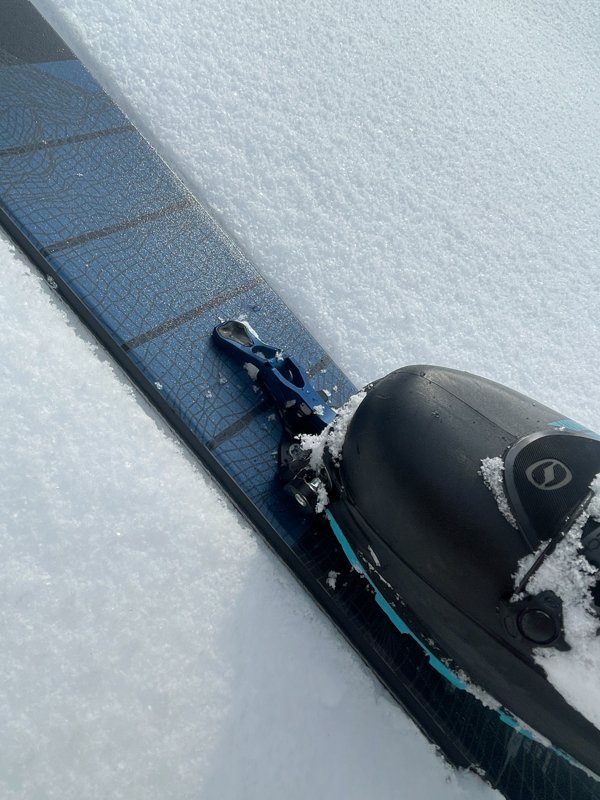
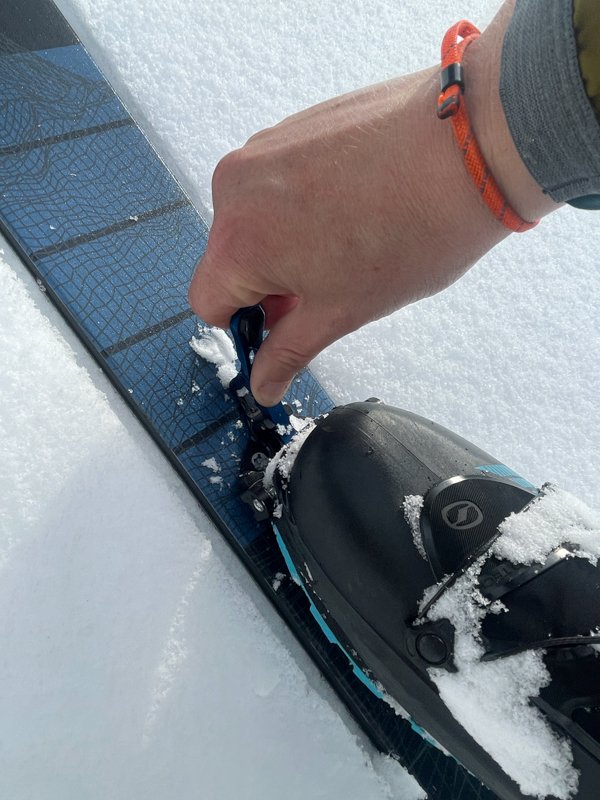
As an owner of the previous model as well, I was pleased to note how the toe lock system for climbing has been improved. On the new Crest 10 there is in fact a more generous lever, derived from the Raider series, for a consequent lever effect that reduces the intervention effort. Locking and unlocking the front lever is easy to do with your hands, whether or not you are wearing gloves, even heavy ones.
The ‘step-in’ system has also been greatly improved, and pin insertion occurs without difficulty even when we are not exactly on level ground. A considerable help even for beginners.
The crampon holder is integrated into the binding, but is optionally removable for those who want to save a few grams.
Heel
The attachment of the boot to the heel is the characteristic Cam Release System®, the exclusive system adopted by ATK that provides stable yet smooth descent performance.
I found the rear step-in operations always precise, and the heel always stable, with the correct release of the flex on the ski by the binding. Another device adopted on the Crest by ATK is the Elastic Response System® , which allows the heel to slide towards the tail in ski flex and compression situations, repositioning itself after the stress event.

A 20 mm plate is integrated in the heel area to ensure quick adjustment in the event of a boot change.
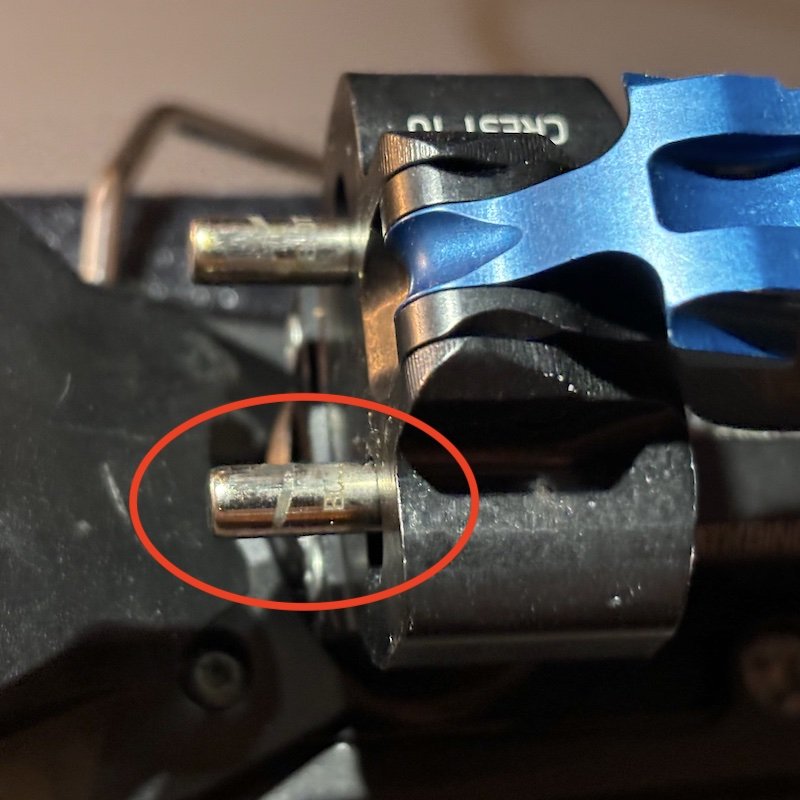
By the way, when using the same binding with more than one boot, this new version of the ATK Crest 10 features a curved laser engraving on the heel pins, which makes it very easy to adjust the heel distance of the boot without using the classic plastic spacers. I personally have three boots of two slightly different lengths and have found ATK’s system quick and functional.
With regard to DIN, which measures binding release force, the heel offers a range from a minimum of 4 to a maximum of 10, both laterally and vertically. A DIN of 10, as offered by the Crest, is adequate for most skiers. However, for those who are heavy and ski very aggressively and therefore put a lot of strain on the binding, bindings with higher DIN values are recommended.
The heel lift
The heel lift was perhaps the really only major shortcoming of the previous model. Changing from one height to another required several manoeuvres, including rotating the heel riser in order to be able to use the higher height support; not exactly easy in some contexts.
Now at last the Crest 10 adopts three walking positions: the base and two that can be managed with the heel lifter. The change between the various heights can be made with the use of just the pole thanks to the Magneto Heel Flaps® system, which offers the possibility of changing the setting with a minimum of effort, as the flanges are joined together thanks to magnets and without mechanical joints.

The ski-brake
The Ski-Brake adopted by ATK, known as the ‘AP Brake System’, may appear essential at times, in the philosophy of containing weight, but it is effective. The brake is generous, with strong, deep levers that bring the mechanism to a performance similar to that of a piste binding brake even if, personally, I would have preferred slightly more accentuated teeth to favour grip on hard snow. Compared to the models I use on my other skis (Raider 12 and previous Crest 10), which are equipped with a rear toggle lock, the Crest 10 is equipped with theAutomatic Brake System®. This has the great advantage that no further intervention is required to activate the ski-brake, as it is sufficient to engage the heel.
Obviously, care must be taken when removing the ski on a slope because, as the brake is locked under the heel and in the rest position, it will not release, as happens with classic ATK models equipped with a rear lever. To activate it however, once released, it is necessary to rotate the heel pad so that the brake is activated. Without this manoeuvre, especially on slopes, the risk is to watch the ski return to the valley without you.

Skiing Feeling
Talking about the feeling of a binding necessarily entails entering a partially subjective field, which depends very much on the skills of each individual skier and what they have been used to using during their career. I will, however, try to make a comparison based on my experience and other bindings, including ATK, that I have used over the years, including the previous version of the Crest 10.

The ATK Crest 10, thanks to the improvements adopted, comes a little closer to the versatility and comfort of the Raider 12, which in my opinion is one of the best bindings currently on the market. Definitely better in use than the previous version of the Crest. However, the Crest is dedicated more to those who want to tackle classic ski mountaineering outings than free touring, even if it does not disfigure in fast touring-oriented use.
In short, a binding for those who in skialp are looking for the ascent, long tours and who know that they may also have to carry their skis on their rucksack before tackling the descent with satisfaction. To summarise, the ATK Crest 10 loses a little in the transmission of impulses compared to the Raider 12, in favour of a lighter weight and greater versatility in use.

Don't miss the next reviews!
Receive product tests for your mountain activities by email.
Recommended for
The ATK Crest 10 is a transverse binding, which will appeal to many because of its great balance between weight, ease of use and performance. It is recommended for both beginners andexperts: the former will appreciate its ease of use, the latter its versatility and low weight.
In my opinion, it performs best when mounted on skis of intermediate width (85/93) on days with long tours and significant altitude differences.
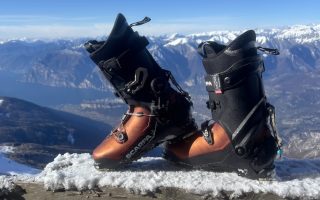
I think the winning combination is with a boot that is not excessively structured, perhaps dedicated to fast touring (such as Scarpa F1XT, La Sportiva Kilo) or touring (Scarpa Maestrale).